5 Ways to Teach and Encourage Respect
In preparation for our monthly Kindness & Empathy™ focus at Stepping Stone School, I asked my four-year-old about respect. He thought about it for several moments and then offered an exasperated reply: “I don’t know — what is it?” I found myself equally challenged to put it into words, and fell back on examples of times we had seen respect in action, in the way people talk to one another, wait their turn, and treat others with care.
Respect is one of those character traits you recognize immediately when you see it, and just as quickly when it’s missing. And while it can be difficult to define for a four-year-old, it is absolutely something that can be taught, modeled, and nurtured, starting in the earliest years of childhood.
At Stepping Stone School’s campuses across Austin, Round Rock, Pflugerville, Kyle, Leander, and Cedar Park, TX, respect is a cornerstone of our Kindness & Empathy™ curriculum. Our educators work intentionally every day to give children opportunities to practice and discuss respectful behavior, and the most powerful results happen when families and schools work together. Here are five ways we can do that as partners:
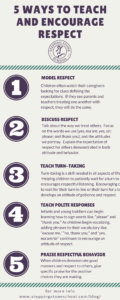
1. Model Respect at Home and at School
Children are natural observers. Long before they can communicate what respect means, they are watching the adults in their lives for clues about how people are supposed to treat one another. When Central Texas parents and teachers consistently treat each other, and the children themselves, with kindness, patience, and consideration, children learn those norms as simply the way things are done.
This is why modeling is the single most powerful tool available to parents and educators. You don’t have to give a lesson on respect; you have to live it. The way you speak to a cashier at the grocery store, the way you respond when someone cuts you off in traffic, the way you handle disagreement with a friend, your child is watching all of it, and learning from every moment.
2. Talk About Respect in Everyday Moments
As children grow, weaving conversations about respect into everyday life makes the concept concrete and meaningful. Austin-area families can focus these conversations on two things: the words we use and the attitudes we carry.
Words matter enormously. Teaching children to say “please,” “thank you,” “yes ma’am,” “yes sir,” and “excuse me” gives them a practical vocabulary for showing respect. But equally important is helping children understand the attitude behind the words, that we use these phrases because we genuinely value the people around us, not just because we’ve been told to. At Stepping Stone School, our educators reinforce this distinction daily, helping Central Texas childrenunderstand that respect is something you feel and show, not just something you say.
3. Teach Turn-Taking as a Foundation for Respect
Turn-taking is one of the earliest and most important building blocks of respectful behavior, and it’s a skill that serves children in every area of life, from classroom discussions to adult relationships. At Stepping Stone School’s campuses across Austin, Round Rock, Pflugerville, Kyle, Leander, and Cedar Park, we embed turn-taking practice into everything from group play to structured learning activities.
At home, Central Texas parents can reinforce this by encouraging children to wait patiently for their turn to speak during family conversations, to share toys without prompting during playdates, and to wait in line without complaint. Each of these moments is a small but meaningful lesson in the larger value of respecting others’ time, space, and needs.
4. Introduce Polite Responses From the Very Beginning
It’s never too early to begin. Even infants and young toddlers can start learning to communicate respect through American Sign Language (ASL) signs for “please” and “thank you” — a practice Stepping Stone School begins in our infant classrooms and builds upon throughout the early childhood years.
As children begin vocalizing, expanding their vocabulary to include phrases like “excuse me,” “no, thank you,” and “yes ma’am/sir” continues to build their respectful communication toolkit. For Central Texas families, integrating these phrases into daily routines like mealtimes, bedtime, or errands makes them feel natural rather than forced, and children who use them consistently carry that habit with them into school and social settings.
5. Praise Respectful Behavior Specifically and Genuinely
Positive reinforcement is one of the most effective tools in a parent’s or educator’s toolkit, but the key is being specific. Rather than a general “good job,” try naming exactly what your child did well: “I noticed how you waited your turn to speak at dinner tonight, that was really respectful,” or “Thank you for saying please without being reminded. That meant a lot.”
Specific praise does two things: it tells your child exactly which behavior you want to see more of, and it makes them feel genuinely seen and valued, which is a form of respect. At Stepping Stone School, our educators are trained to offer this kind of specific, meaningful acknowledgment every day across all of our Central Texas campuses.
How Stepping Stone School Nurtures Respect Every Day
Respect doesn’t develop from a single lesson, it grows through time, consistency, and an environment where it is modeled, discussed, and celebrated at every turn. At Stepping Stone School’s campuses in Austin, Round Rock, Pflugerville, Kyle, Leander, and Cedar Park, our Kindness & Empathy™ curriculum ensures that respect is not just a topic of the month, it’s a way of life.
Time and consistency together with our intentional teaching efforts will teach children this valuable character trait. Hopefully, next time I ask my child about respect, he will be able to provide me with a definition of his own.
Resources:
Ask Dr. Sears. (2013, August 23). “7 Ways to Teach Your Child Manners.” Retrieved on February 18, 2016 from http://www.askdrsears.com/topics/parenting/discipline-behavior/morals-manners/7-ways-teach-your-child-manners
Kear, N. (2010). “The Return of Respect!” Retrieved on February 18, 2016 from www.parents.com/toddlers-preschoolers/development/manners/the-return-of-respect/
Silverman, R. (2008, April 12). “10 Tips on Teaching Respect to Children: You can’t get it if you don’t give it!” Retrieved on February 18, 2016 from http://drrobynsilverman.com/parenting-tips/10-tips-on-teaching-respect-to-children-you-cant-get-it-if-you-dont-give-it/
VanClay, M. (2007). “The respectful child: How to teach respect.” Retrieved on February 18, 2016 from http://www.babycenter.com/0_the-respectful-child-how-to-teach-respect_64686.bc