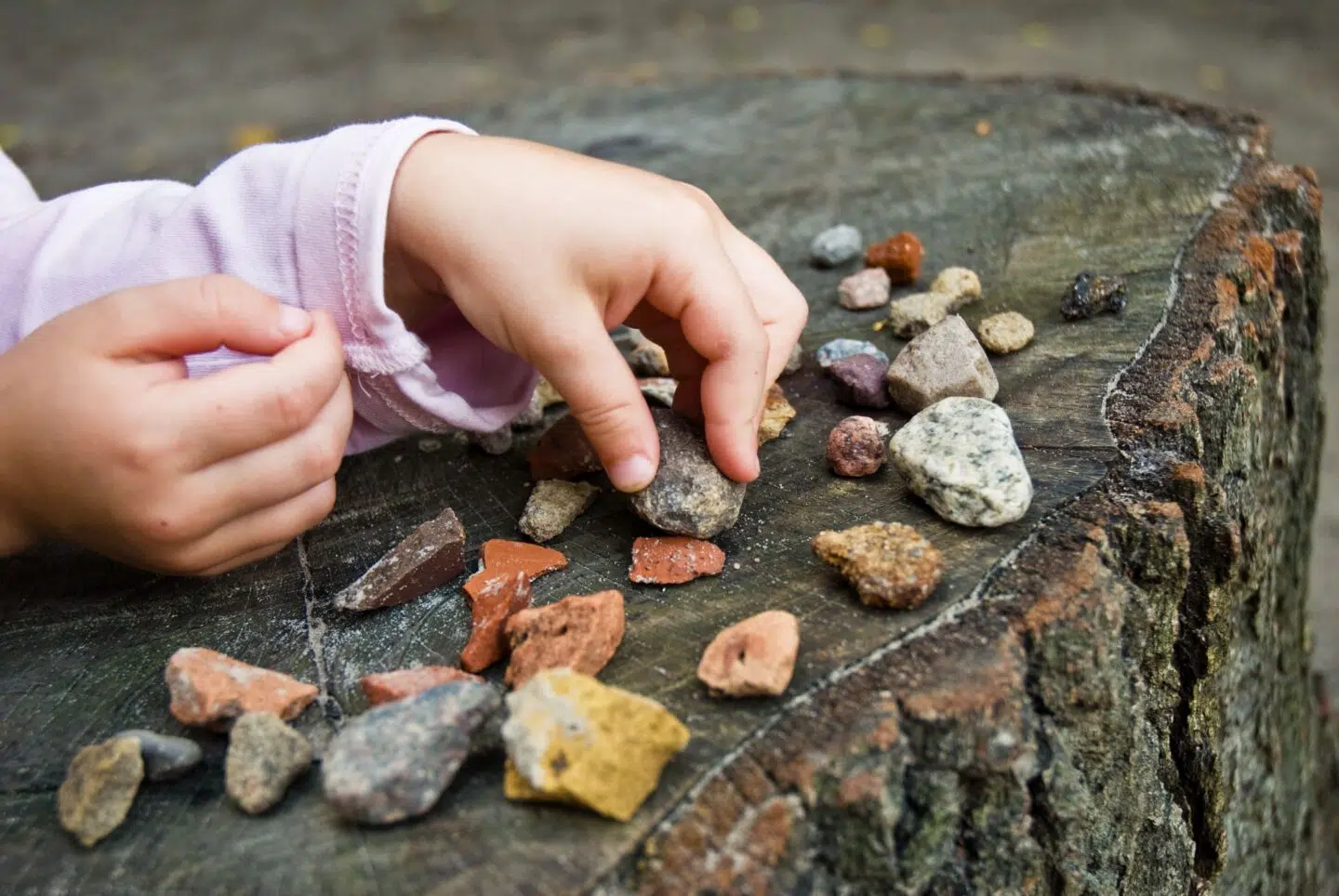
Four-year-old, Ethan, was huddled over a pile of rocks he had collected from around the playground. As I walked over to him, he told me he was looking for “interesting” rocks. Naturally, I wondered what made a rock “interesting.” As I watched, he began sorting his rocks into several piles according to the level of interest: crystal-like formations, streaks of a different color, or a unique shape.
I asked him to tell me which pile had more and then watched as he pointed. Pressing further, I inquired as to how he knew it had more. First, he compared the size of the piles showing me which one was tallest, then he counted the rocks in each pile. After answering my questions accordingly, he resumed his play.
Watching from across the yard, I continued to observe him for several minutes. Still huddled over the piles of rocks, he began lining up his rocks in rows of ten. Several minutes later, he began to create patterns until finally, he used the rocks to build a tower balancing one upon the other. For a solid 35 minutes Ethan experimented with math concepts during play using what has been categorized as “Loose Parts.”
The Theory of Loose Parts was developed by Simon Nicholson who stated, “In any environment, both the degree of inventiveness and creativity, and the possibility of discovery, are directly proportional to the number and kind of variables in it” (Nicholson, 1972, p 6). Nicholson believed children to be naturally curious and creative beings and therefore theorized that if you provide children with “loose parts” (materials which can be moved around, combined, reformed, designed, and redesigned in any number of different ways) they are more likely to creatively engage with those materials and the environment. (Ruzzi, March 2017).
At Stepping Stone School, our Platinum Learning for Life™ curriculum which incorporates S.T.E.A.M. (Science, Technology, Engineering, Arts, and Mathematics) programming is largely based on this idea of loose parts. Each early childhood classroom is filled with open-ended math manipulatives, building blocks, and art supplies so that our children may use these tools creatively.
The Atelier™ was founded on the premise that if we provide children with the loose parts and inspiration found in learning about what others have created, then they too, will apply their learning and create great works of art and engineering in the years to come.
Out on the playground, Ethan thought he was “just playing,” but we can see the critical thinking and the math applications involved. Loose parts connect academic learning with the realms of play and exploration. Along with Albert Einstein, we believe, “Play is the highest form of research.”
Resources:
Nicholson, S. 1972. “The Theory of Loose Parts: An Important Principle for Design Methodology.” Studies in Design Education Craft and Technology 4 (2): 5–14. Retrieved on July 5, 2017 from https://ojs.lboro.ac.uk/SDEC/article/view/1204
Ruzzi, B. and Eckhoff, A. (2017, March). “STEM Resources and Materials for Engaging Learning Experiences.” Young Children. Vol. 72, No. 1. Retrieved on July 5, 2017 from http://www.naeyc.org/yc/stem-engaged-learning