
Each month, Stepping Stone School classroom teachers focus on specific activities to teach character development in an age-appropriate manner through our custom-created Kindness and Empathy™curriculum which is part of our Platinum Learning for Life™curriculum.
Our focus for the month of October is the character trait of integrity. Integrity means following through with what you say you will do, doing what is expected of you no matter who is watching, and demonstrating consistency in both your words and actions.

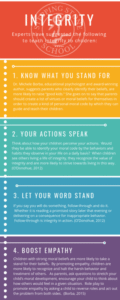
Experts have suggested the following to teach integrity to children:
1. Know What You Stand For
Dr. Michele Borba, an educational psychologist, and award-winning author suggests parents who clearly identify their beliefs, are more likely to raise “good kids.” She goes on to say that parents should create a list of virtues or moral beliefs for themselves in order to create a kind of personal moral code by which they can guide and teach their children. (Borba, 2015)
2. Your Actions Speak
Think about how your children perceive your actions. Would they be able to identify your moral code by the behaviors and habits they observe in your life on a daily basis? When children see others living a life of integrity, they recognize the value of integrity and are more likely to strive towards living in this way. (O’Donohue, 2012)
3. Let Your Word Stand
If you say you will do something, follow-through and do it. Whether it is reading a promised story later that evening or delivering on a consequence for inappropriate behavior. Follow-through is integrity in action. (O’Donohue, 2012)
4. Boost Empathy
Children with strong moral beliefs are more likely to take a stand for their beliefs. By promoting empathy, children are more likely to recognize and halt the harsh behavior and treatment of others. As parents, ask questions to stretch your child’s moral development, encourage your child to think about how others would feel in a given situation. Role play to promote empathy by asking a child to reverse roles and act out the problem from both sides. (Borba, 2015)
With consistency, as we partner together, children will learn the value of integrity and grow in their own character development from an infancy through adulthood.
Resources:
Borba, M. (2015). “Seven Ways to Build Strong Character and Integrity in Children.” Retrieved from http://micheleborba.com/blog/seven-tips-to-build-strong-character-and-help-kids-stand-up-for-their-moral-beliefs/
O’Donohue, M. (2012). “Teaching Children to Have Integrity.” Retrieved from http://www.pbs.org/parents/experts/archive/2013/01/teaching-children-to-have-inte.html