“Gardens offer children perfect laboratories where scientific concepts literally come to life.”
-Pam Mohrmann, author and educator

My three-year-old can tell you the parts of a plant, a plant’s life cycle, and which parts of the plant are good to eat. He can identify several insects that help our plants along with several of the harmful ones. He enjoys pulling weeds, inspecting fruit and vegetables, and eating them fresh from our garden. This knowledge is the result of numerous experiences “playing” in the garden.
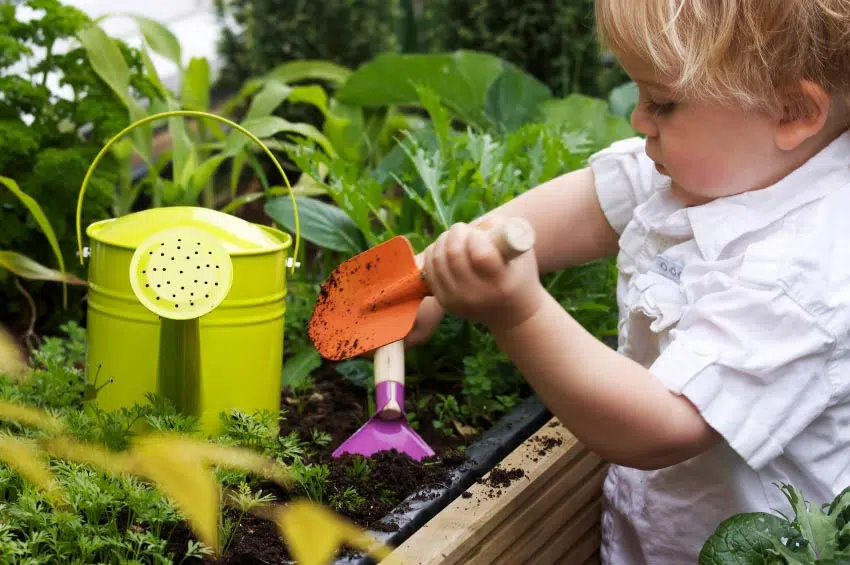
Shortly after his second birthday, I gave him his first pair of gardening gloves and a plastic set of garden tools. Each season, he has worked alongside me preparing the soil, selecting and planting the seeds, pulling weeds (along with some of the plants we wanted to keep), watering the seedlings, and finally harvesting our fruits and vegetables.

According to research, gardening with young children provides a meaningful activity intertwined with the three elements of scientific education – attitude, process skills, and content (Hachey & Butler, 2009).
Scientific Attitude. Gardening invites children to investigate the natural world through the interaction and observation of a garden ecosystem through hands-on experiences. These experiences, in turn, build a positive scientific attitude encouraging a child’s natural curiosity.
Science Process Skills. Allowing children to explore and find answers to their questions about the world and how it works while enabling them to use tools like rulers and magnifying glasses as they observe and collect data directly from the garden.
Scientific Content. Learning scientific facts and concepts through the hands-on study of plants and nature. Providing, in this case, a first-hand opportunity to observe a plant as it goes through its life cycle over several weeks.
From an early childhood education perspective, gardening and nature play is:
| Learner-centered | Intrinsically motivating and rewarding |
| Hands-on | Promotes sensory exploration |
| Inclusive | Connects children of all cultures, all ages, and all skill levels |
| Socially bonding | Provides interesting things to talk about and work on together |
| Emotionally uplifting | Builds self-efficacy and self-esteem |
| Physically stimulating | Promotes fine and gross motor skills |
| Integrative | Allows for seamlessly incorporating science, math, reading, social studies, and the arts |
| Aesthetically appealing | Offers opportunities to create and appreciate the beauty of the natural world |
| Hachey & Butler, 2009 | |
At most of our campuses, Stepping Stone School is embarking on a new type of curriculum experience: An outdoor garden. Through purposeful instruction and hands-on experiences, we look forward to engaging children in meaningful activities nurturing a positive scientific attitude, process skills, and scientific content as we explore and learn in our outdoor gardens.
Resources:
Hachey, A. and Butler, D. (November 2009). Seeds in the Window, Soil in the Sensory Table: Science Education through Gardening and Nature-Based Play. Young Children. Retrieved on April 18, 2017 from http://www.shelburnefarms.org/sites/default/files/science_education_thru_gardening-naeyc.pdf
Nimmo, J. and Hallett, B. (January 2008). Childhood in the Garden: A Place to Encounter Natural and Social Diversity. Beyond the Journal: Young Children on the Web. Retrieved on April 18, 2017 from https://www.naeyc.org/files/yc/file/200801/BTJNatureNimmo.pdf