Building Early Writing Skills in Toddlers and Preschoolers
Wrapping his tiny toddler fingers tightly around a large crayon, two-year-old Bentley stands over a piece of paper making firm strokes across the page and announces with excitement, “I write!”
Considering her picture from different angles, Mila adds a few letter-shapes — pointy marks reminiscent of M’s and repeating lines like L’s.
After adding eyes and whiskers to his drawing, Jamie thinks intently. Very carefully he adds a wobbly “c” and then shows his teacher with pride: “I wrote, Cat!”
Three children. Three different stages. All of them writing — and all of them doing it exactly right.
At Stepping Stone School’s campuses across Austin, Round Rock, Pflugerville, Kyle, Leander, and Cedar Park, TX, scenes like these play out every single day. Early writing skills develop in a predictable sequence of stages, and each mark a child makes on a page — from the boldest scribble to the first recognizable letter — represents a meaningful step forward in their literacy journey. Our role as educators, and yours as parents, is to understand that sequence and create the conditions where every stage is celebrated and supported.
Why Early Writing Matters for Literacy Development
Writing and reading are two sides of the same coin. Research in early literacy consistently shows that children who are given regular, meaningful opportunities to write — even through scribbles, drawing, and invented letters — develop stronger phonological awareness, letter recognition, and reading comprehension than children who are not. For Central Texas families thinking about kindergarten readiness, this connection is important: building a foundation in writing is building a foundation in reading at the same time.
At Stepping Stone School, laying this foundation is a deliberate, daily priority across every one of our Austin, Round Rock, Pflugerville, Kyle, Leander, and Cedar Park campuses. It begins long before children can hold a pencil correctly — and it starts with the body.
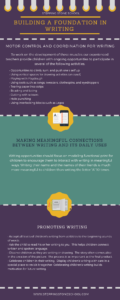
Building Motor Control and Coordination for Writing
The ability to write depends on the physical development of specific muscles in a child’s hands and forearms, along with the development of eye-hand coordination. These aren’t skills that appear overnight — they are built gradually through play-based activities that strengthen the small muscles children will eventually use to form letters and words.
At Stepping Stone School, our experienced educators provide Central Texas children with ongoing, intentional opportunities to develop these foundational muscles through activities including climbing, turning, and pushing up on play structures to build arm and shoulder strength, using vertical surfaces like easels for drawing to develop wrist control, playing with playdough to strengthen hand muscles, working with tools like tongs, tweezers, clothespins, and eyedroppers to build pincer grip, tearing paper into strips, beading and lacing, cutting with scissors, hole punching, and building with interlocking blocks like Legos.
Every one of these activities looks like play — because it is. And every one of them is directly preparing Austin-area children for writing!
Making Writing Meaningful and Purposeful
One of the most important principles guiding our approach to early writing at Stepping Stone School is this: writing should always feel purposeful. Writing the letter “A” ten times in a row holds very little meaning for a young child. Writing their own name, or the name of a friend, holds enormous meaning — because it connects the act of writing to something real and personal in their world.
This is why our Pre-Kindergarten classrooms across Central Texas place a notepad in the dramatic play center so children can take each other’s “orders” — just like at a restaurant. It’s why we encourage parents to hand their child a piece of paper and ask them to write the grocery list before heading to the store, then read it back together. These small, everyday writing experiences teach children that writing is a tool for communicating, connecting, and participating in the world — not just a school exercise.
Writing opportunities should always focus on modeling functional print. The more children see writing used purposefully by the adults around them, the more motivated they become to participate in it themselves.
How to Promote and Celebrate Early Writing at Home
Central Texas parents play a powerful role in supporting their child’s writing development at home. Here are the most impactful things you can do:
Accept all levels of writing as valid. From scribbles to letter strings to invented spelling — every stage is legitimate and developmentally appropriate. Resist the urge to correct or redirect. Instead, show genuine curiosity.
Ask your child to read their writing to you. This single habit is one of the most powerful things a parent can do. When children explain what their marks mean, they are actively connecting written symbols to spoken language — one of the most critical pre-literacy skills there is. You will often be surprised by the rich stories living inside what looks like a simple scribble.
Watch the process, not just the product. Observe your child as they draw and write. The story frequently comes alive during the act of creation — in the sounds they make, the movements they use, the way they narrate as they go. The process matters as much as the finished piece.
Display children’s writing with pride. Hanging your child’s writing and drawing in a place of honor — on the refrigerator, in a frame, on a dedicated wall — tells them that their work has value. At Stepping Stone School, we celebrate children’s writing across all of our Central Texas campuses in exactly this way, because children who feel proud of their early efforts are children who keep writing.
The Foundation We Build Together
At Stepping Stone School, every crayon stroke, every wobbly letter, every proudly announced “I write!” is treated as exactly what it is — a meaningful step in a child’s journey toward literacy. Our educators across Austin, Round Rock, Pflugerville, Kyle, Leander, and Cedar Park are trained to meet children exactly where they are in their writing development and to create the rich, low-pressure environment where the next step forward happens naturally.
The foundation we build in these early years lasts a lifetime!
References:
Center for Early Literacy Learning. “Art of Writing” and “Get Write on It!” retrieved from http://www.earlyliteracylearning.org/cellpract_parent/toddler/collections/CELL_Todd_Scrib_Draw.pdf
Early Literacy Pre-Writing Skills. Retrieved from http://familychildcareacademy.com/early-literacy-pre-writing-skills/
Geiger, A. (2014). Teaching Tips for Children in Different Stages of Writing Development. Retrieved from http://www.themeasuredmom.com/stages-of-writing-development-help-kids-move/
“Writing Growth Stages” and “The Developmental Stages of Writing” Retrieved from http://www.learningtowrite.ecsd.net/stages%20of%20writing.htm